• CALL 1300 002 484
  • Email Us >>
  • Skip to primary navigation
  • Skip to main content
  • Skip to primary sidebar
Citi Industries

Citi Industries

Email Us
  • Services
  • Products
  • Resources
  • Case Studies
  • About
  • Contact
    • Wash Bay Construction FIND OUT MORE
    • Grease Trap Installation FIND OUT MORE
    • Grease Trap Lid Installation FIND OUT MORE
    • Plumbing Installation FIND OUT MORE
      • Storm Water Installation FIND OUT MORE
      • Hot Water Systems FIND OUT MORE
      • Gasfitting FIND OUT MORE
      • Backflow DevicesFIND OUT MORE
      • Commercial Plumbing FIND OUT MORE
      • Industrial Plumbing Design FIND OUT MORE
    • Plumbing Design FIND OUT MORE
  • Grease Trap RangeFIND OUT MORE
    • Above Ground CHECK SIZES
    • Below Ground CHECK SIZES
    • LID REPLACEMENT FIND OUT MORE
    • Regulations FIND COUNCIL RULES
    • Pumps CHECK SIZES
    • Septic Tanks GET A QUOTE
  • Pump Stations FIND OUT MORE
    • Sewer Pump Stations CHECK SIZES
    • Storm Water Pump Stations CHECK SIZES
    • Diaphragm Pumps CHECK SIZES
  • Oil Water Separators CHECK SIZES
  • Holding Tanks CHECK SIZES
  • Grease Trap Lids CHECK SIZES
  • Grease Trap Regulations FIND OUT MORE
  • News & Insight FIND OUT MORE
  • About
  • Wash Bays
    • Oil Water Separators
    • Sewer Pump Stations
    • Diaphragm Pumps
    • Bunding
    • Wash Bay Design
  • Grease Traps
    • Above Ground
    • Below Ground
    • Lid Repairs
    • FIND COUNCIL RULES
    • Pumps
    • Septic Tanks
  • Plumbing
    • Commercial Plumbing
    • Industrial Plumbing
    • Stormwater
    • Hot Water
    • Gasfitting
    • Backflow Devices
    • Plumbing Design
  • Case Studies
  • Contact
  • Services
  • Products
  • Resources
  • Case Studies
  • About
  • Contact

Case Plumbing

Above Ground Grease Trap Installation Brisbane QLD

Above ground grease trap installation project in a Brisbane City CBD building

Not every kitchen can bury a grease trap in the ground, and a Brisbane City dessert shop was a clear example. The tenancy sat within a busy CBD building where digging simply was not an option. Instead, the site needed an above ground grease trap that could handle the kitchen’s output without civil works.

For that reason, the operator engaged Citi Industries to design and fit a custom solution. The answer was a twin-tank unit built to suit the space and the volume.

Project Overview

This above ground grease trap installation centred on a custom twin-tank 2000-litre unit with screw lids. Because the location ruled out excavation, the entire system sat at floor level and ran along the wall. That approach kept the job clean, fast, and free of concrete cutting.

The brief also covered removing the old tank, running new drainage, and leaving a provisional point for a future tenant. Therefore, the work served both the current kitchen and the building’s next occupant.

Key scope items included:

  • Custom twin-tank 2000-litre above ground grease trap with screw lids
  • Trade waste drainage connecting the kitchen to the new unit
  • Removal of the old tank to a refuse centre, with the pump-out handled by others
  • New trade waste line run along the wall to the kitchen area
  • A provisional connection point left ready for the incoming tenant
  • One RPZD backflow valve fitted on the closest hosetap
  • Pedestrian barricading across the affected area during the works

Narrow Brisbane City CBD plant area with no ground access for grease trap installation

Challenges

A dessert shop still produces fats and sugars that cannot flow straight to the sewer. Under Urban Utilities trade waste guidelines, that waste needs interception before it reaches the network. So even a compact CBD kitchen requires a properly sized grease trap.

The building itself set the hardest limit. With no ground to dig and tight floor space, a standard tank would not fit. As a result, the team designed a custom twin-tank unit, splitting the 2000-litre capacity across two linked vessels. This layout slid into the available footprint while keeping the full treatment volume.

Working in an occupied CBD address brought its own demands. Pedestrians passed close to the work zone, so barricading stayed up throughout.

Key constraints on this project:

  • No ground available, which made an above ground grease trap the only path
  • Tight CBD footprint required a custom twin-tank design rather than a single tank
  • Old tank needed removal and disposal before the new system could take over
  • A provisional point had to be left for a future tenant’s fit-out
  • Pedestrian traffic close to the site called for constant barricading

Custom twin-tank above ground grease trap with labelled inlet, outlet and vent

Solutions

Citi Industries planned the install around the building’s limits and the operator’s timeline. Each stage below kept disruption to the tenancy low.

Clearing the Old Tank

First, the existing tank came out. A separate contractor pumped it down, then the crew removed the unit and carted it to a refuse centre. Clearing the old equipment opened the floor space the new system needed. Subsequently, the area was ready for the custom build.

Designing and Setting the Twin-Tank Unit

Next, the team installed the custom twin-tank 2000-litre grease trap with screw lids. A grease trap intercepts fats and oils, holding them while clean water passes to the sewer. Splitting the capacity across two tanks let the unit fit a space a single 2000-litre tank never could.

Screw lids suit an above ground setting, since they seal firmly and open easily for servicing. For comparable sites, our above ground grease traps range covers a spread of capacities.

Wall-Run Drainage and a Provisional Point

Then, the crew ran the new trade waste line along the wall to the kitchen area. A wall run avoids floor penetrations, which matters in a leased CBD tenancy. The team also left a provisional connection point for the incoming tenant.

That foresight saves the next operator from reopening finished work. Our commercial plumbing services often build in this kind of allowance during a fit-out.

Backflow Protection

Finally, the team fitted an RPZD backflow valve on the closest hosetap. An RPZD, or Reduced Pressure Zone Device, stops contaminated water flowing back into the mains. Because the kitchen connects to a trade waste area, this valve is a compliance requirement rather than an optional extra.

Completed above ground grease trap installation in a Brisbane City CBD tenancy

Final Outcome

A CBD tenancy that could not take a buried tank now runs a compliant above ground grease trap. Citi Industries completed the Brisbane install in December 2025 without disrupting the surrounding businesses. As a result, the dessert shop trades legally, and the building is ready for its next tenant.

  • Custom twin-tank 2000-litre unit fitted where no below-ground option existed
  • Old tank removed and disposed of cleanly before the new build
  • Wall-run drainage avoided floor penetrations in the leased space
  • Provisional point and RPZD valve left the system future-ready and compliant

Since the work met Queensland regulated plumbing work requirements, the operator holds a system that stands up to inspection. The provisional point also adds value for the landlord and the next occupant.

Final Thoughts

A tight CBD kitchen does not have to settle for a poor trade waste solution. When the ground is off-limits, a well-designed above ground grease trap does the same job at floor level. However, the fit only works when the design matches the space.

Citi Industries builds custom units for exactly these situations. Because of that, operators in awkward tenancies still get full treatment capacity and clean compliance. The team measures the space, designs to suit, and leaves the site ready for what comes next.

Whether you run a dessert shop, a cafe, or a full kitchen, a custom grease trap can fit where a standard one cannot. Request a grease trap quote and the team will assess your space and your trade waste needs.

Call Citi Industries on 1300 002 484 to discuss your project.

Shopping Centre Trade Waste Plumbing in North Ipswich, QLD

Fitting out a tenancy inside a live shopping centre is a different discipline to working on a standalone site. A bubble tea retailer in North Ipswich needed drainage, trade waste, and water supply brought into a bare shop. Every metre of that work had to thread through a busy multi-level building without disturbing it.

For that reason, the tenant engaged Citi Industries to deliver the plumbing fit-out. The job called for under-slab pipework, fire-rated penetrations, and a long run to a shared grease trap.

Project Overview

This shopping centre trade waste project connected a new beverage tenancy to the building’s existing services. Because the work sat below the slab, the team suspended pipework rather than digging trenches. That approach suited a centre where the floor above stayed in use throughout.

The scope blended drainage, trade waste, fire protection, and water supply into one coordinated fit-out. Each element followed the tenancy plan and the centre’s base-build infrastructure.

Key scope items included:

  • Eight core-drilled penetrations, allowed for plumbing works only
  • Fire collars supplied and fitted to all penetrations through the slab below centre level
  • New trade waste pipework suspended under the slab to each fixture as per plan
  • Connection to the existing base-build trade waste line below the shop lease line
  • A new trade waste line run roughly 80m to shared grease trap number six
  • A new 20mm cold water line drawn up through the slab into the tenancy

Challenges

A shopping centre is a shared, fire-rated structure, so plumbing cannot simply pass through it. Every penetration through the slab breaks a fire barrier that must then be restored. Therefore, fire collars were essential on all eight core holes to seal each opening against fire spread.

Distance posed the second hurdle. The tenancy’s nearest shared grease trap, unit six, sat near the central ramp by Ultra Tune. That point lay roughly 80m from the lease line, so the new trade waste line had to travel a long suspended path under the slab. Maintaining correct fall across that distance took careful planning.

Working below an operating centre added constant coordination. Under Urban Utilities trade waste guidelines, the connections also had to meet trade waste standards.

Key constraints on this project:

  • Eight slab penetrations each needed a fire collar to restore the fire rating
  • The shared grease trap sat roughly 80m away near the central ramp
  • Trade waste pipework had to hold correct fall across a long suspended run
  • All work stayed below the shop lease line and the centre slab
  • Connections had to tie cleanly into existing base-build infrastructure

Solutions

Citi Industries staged the fit-out to work with the centre, not against it. Each phase below kept the building’s systems intact.

Coring and Fire-Rated Penetrations

To begin, the team core-drilled eight penetrations through the slab, strictly for the plumbing works. Each opening then received a fire collar. A fire collar is a fitting that wraps a pipe penetration and seals it shut under heat, holding the slab’s fire rating.

This step is non-negotiable in a shared building, since an unsealed penetration weakens the whole structure’s fire defence. Our commercial plumbing services treat fire-stopping as core to any centre fit-out.

Suspended Under-Slab Trade Waste

Next, the crew ran new trade waste pipework suspended beneath the slab. The line reached each fixture as set out in the tenancy plan, then tied into the existing base-build trade waste line below the lease line. Suspending the pipe avoided cutting the floor above, which kept the centre trading.

Holding the right gradient mattered most here. The team set each hanger so waste flowed freely toward the connection point.

The 80m Run to the Shared Grease Trap

Then came the longest leg of the job. The tenancy had to discharge to grease trap number six, near the central ramp by Ultra Tune, around 80m away. So, the crew extended a new trade waste line from the lease line, below the slab, the full distance to that trap.

Across 80m, fall is everything, because too little slope stalls the flow. The work followed Queensland regulated plumbing work requirements to keep the long run compliant and free-draining.

Cold Water Supply and Accessible Metering

Finally, the team drew a new 20mm cold water line from the existing supply up through the slab into the tenancy. They fitted the water meter on a column rather than a hidden recess. That placement gives easy access for future reading and maintenance, which suits a long-term retail tenancy. You can read how we approach trade waste plumbing installation on similar projects.

Final Outcome

A bare shop now runs as a fully serviced beverage tenancy. Citi Industries completed the North Ipswich fit-out in December 2025 without disrupting the centre around it. As a result, the retailer gained compliant drainage, trade waste, and water supply ready for trade.

  • Eight slab penetrations sealed with fire collars to hold the fire rating
  • Suspended trade waste pipework connected to base-build services below the lease line
  • An 80m trade waste run delivered clean fall to the shared grease trap
  • Cold water connected and metered on a column for easy future access

Because the work met trade waste and plumbing standards, the tenancy holds infrastructure the centre can rely on. The accessible meter also simplifies billing and servicing down the track.

Final Thoughts

Shopping centre fit-outs reward planning over speed. The shared slab, the fire ratings, and the distance to services all shape how the plumbing must run. However, a coordinated approach turns those limits into a clean, compliant result.

Citi Industries plans each tenancy fit-out around the building it sits in. Because of that, retailers open on time without compromising the centre’s systems. The team cores carefully, fire-seals every penetration, and holds fall across even the longest runs.

If you are fitting out a tenancy in a centre or complex, the team can map the works. Enquire about a fit-out, and we will coordinate with base-build services and deliver compliant trade waste and water supply.

Call Citi Industries on 1300 002 484 to discuss your project.


Overflow Relief Gully Installation in Morningside, QLD

Plumbing rules tighten over the decades, and infrastructure that once passed can quietly fall out of step. A meat processing factory in Morningside faced exactly that with its overflow relief gully. The existing ORG met the standards of its build era, yet it no longer satisfied current plumbing regulations.

Because of this, the factory engaged Citi Industries to design and install a compliant replacement. The job demanded precise depth work, careful excavation, and a council sign-off at the end.

Project Overview

This overflow relief gully installation replaced a non-compliant unit at a working factory. The core challenge was depth, since an ORG only protects a building when it sits low enough in the system. Therefore, the team planned the new sewer run around one exact target level.

The scope reached well past the gully itself. It took in concrete cutting, excavation, a new sewer line, a bollard-mounted hosetap, full reinstatement, and a council inspection.

Key scope items included:

  • Replacement of the existing non-compliant ORG with a new compliant unit
  • Concrete scanning to locate all below-ground services before cutting
  • Concrete cutting from the far right front of the factory across to the fence
  • Excavation to the sewer line, with a new line run diagonally to the fence
  • A new ORG set with a finishing collar and grate at the required depth
  • A new bollard-mounted hosetap positioned above the ORG grate
  • Backfilling, spoil removal, and preparation for fresh concrete
  • Steel dowels and mesh drilled into the existing slab before the pour
  • New concrete to the trenches, a full site clean, and one council inspection


Challenges

An overflow relief gully is a grated outlet that sits outside a building. When a sewer blockage builds pressure, the grate lifts and releases the surcharge outdoors rather than inside. According to the QBCC overflow relief gully requirements, the gully must sit at a set level to work safely.

Depth was the defining problem on this site. The new overflow point had to reach close to 225mm below the internal floor level. To pin that down, the team took laser measurements across the area. They found a point roughly 4m from the building corner sitting around 220mm below the internal floor.

Reaching that depth meant running a new sewer line diagonally to the fence. Meanwhile, the old slab hid live services, so scanning had to come before any cut.

Key constraints on this project:

  • The new ORG had to sit close to 225mm below the internal floor level
  • Laser measurement was needed to confirm the exact achievable depth on site
  • A diagonal sewer run to the fence was required to reach that depth
  • Concrete scanning preceded all cutting to protect buried services
  • The completed drainage work required a formal council inspection

Solutions

Citi Industries worked the job from survey through to council sign-off. Each stage below built toward a compliant, lasting result.

Scanning, Cutting and Setting the Levels

To begin, the crew scanned the concrete to map every service below the slab. With the ground confirmed safe, they cut from the far right front of the factory across to the fence. Laser readings then set the target depth, since the ORG fails its purpose if it sits too high.

This kind of survey-led groundwork underpins our industrial drainage solutions, because guesswork has no place near live sewer lines.

Running the New Sewer Line

Next, the team excavated down to the existing sewer. To achieve the required fall and depth, they ran a new line diagonally across to the fence. That diagonal route was the key to hitting roughly 220mm below the internal floor at the chosen point.

Getting this right matters under Queensland regulated plumbing work requirements. An ORG set at the correct level lets a surcharge escape outdoors, which shields the factory interior from sewage backup.

Setting the ORG and the Bollard Hosetap

After the line was in, the crew set the new ORG with its finishing collar and grate. They then ran a water line across from the existing hosetap on the right-side corner. A fresh hosetap went onto a new bollard fixed into the ground, positioned directly above the ORG grate.

That hosetap placement is not optional, since a water point above the grate is required as part of any ORG installation. Our commercial plumbing services build these compliance details in from the start.

Reinstatement and Council Inspection

Finally, the team backfilled the trenches and carted the excess spoil off site. To bond the new slab to the old, they drilled steel dowels and mesh into the existing concrete. Fresh concrete then filled the trenches, followed by a full site clean.

To close the job properly, Citi Industries arranged one council inspection for the drainage work. That sign-off confirmed the new ORG met current standards.

Final Outcome

A factory that carried an outdated overflow point now holds a fully compliant ORG. Citi Industries completed the Morningside works in December 2025 and passed the council inspection. As a result, the building gained proper protection against sewer surcharge.

  • New ORG set close to 225mm below the internal floor, as the standard requires
  • Diagonal sewer run delivered the depth the old layout could not
  • Bollard hosetap installed above the grate to meet ORG installation rules
  • Drainage work inspected and signed off by the council

Since the build followed plumbing compliance and standards Australia, the factory holds infrastructure that suits its current obligations. The reinstated concrete leaves the work zone clean and finished. 

Next Steps

Compliance is not a fixed line, because regulations move and older buildings drift behind them. An ORG that passed on build day can become a liability years later. However, a well-planned replacement brings the site back into step without guesswork.

Citi Industries treats drainage compliance as a precision task, not a rough dig. When depth decides whether a system works, laser-set levels remove the doubt. The team scans first, builds to the standard, and arranges the inspection that proves it.

If your site runs older drainage that may no longer comply, the team can assess it. We provide trade waste plumbing installation, ORG upgrades, and the council liaison a clean handover needs.

Call Citi Industries on 1300 002 484 to discuss your project.

Grease Trap and Commercial Kitchen Plumbing Installation for a Food Manufacturing Facility

A licensed plumber completing a grease trap installation for a commercial kitchen at a food manufacturing facility in Darra, Queensland.

For food manufacturers and commercial kitchens in Queensland, a failing grease trap is more than just a maintenance issue. It can quickly become a trade waste compliance risk, leading to council notices, approval reviews, or even operational shutdowns.

That was exactly the challenge facing a food manufacturing facility in Darra, QLD. Their ageing trade waste infrastructure had deteriorated beyond serviceable condition, the internal plumbing no longer met current regulatory standards, and the clock was ticking on their compliance exposure.

The solution required more than a simple repair. It demanded a fully engineered commercial kitchen plumbing installation, including a new grease trap installation for commercial kitchens, a complete internal hydraulic fit-out, and a trade waste plumbing system designed to meet Queensland compliance requirements from the ground up.

Citi Industries, as experienced commercial plumbing contractors in Queensland, was engaged to deliver exactly that.

Project Overview

This was not a patch job. The existing grease trap had exceeded its serviceable life, the internal plumbing couldn’t support food production demands, and the whole system needed a proper rebuild. On top of that, it all had to happen while the facility kept operating.

We planned every stage carefully, scanned before cutting, staged works around production schedules, and ensured nothing below ground would cause problems later. The scope was substantial and the stakes were real.

Key project objectives included:

  • Supply and installation of a 2,000L below-ground grease trap with Class D vehicular traffic lid
  • Full decommissioning and remediation of the existing grease trap
  • Trade waste drainage system installed as per the approved hydraulic plan
  • Complete internal hydraulic fit-out including cold water, hot water ring main, and sanitary plumbing
  • Installation of 9 bucket traps across the commercial kitchen drainage network
  • RPZD backflow prevention valve and cold water supply to all kitchen fixtures
  • Connection of 4 basins, 2 wash sinks, commercial tapware, and boot wash station

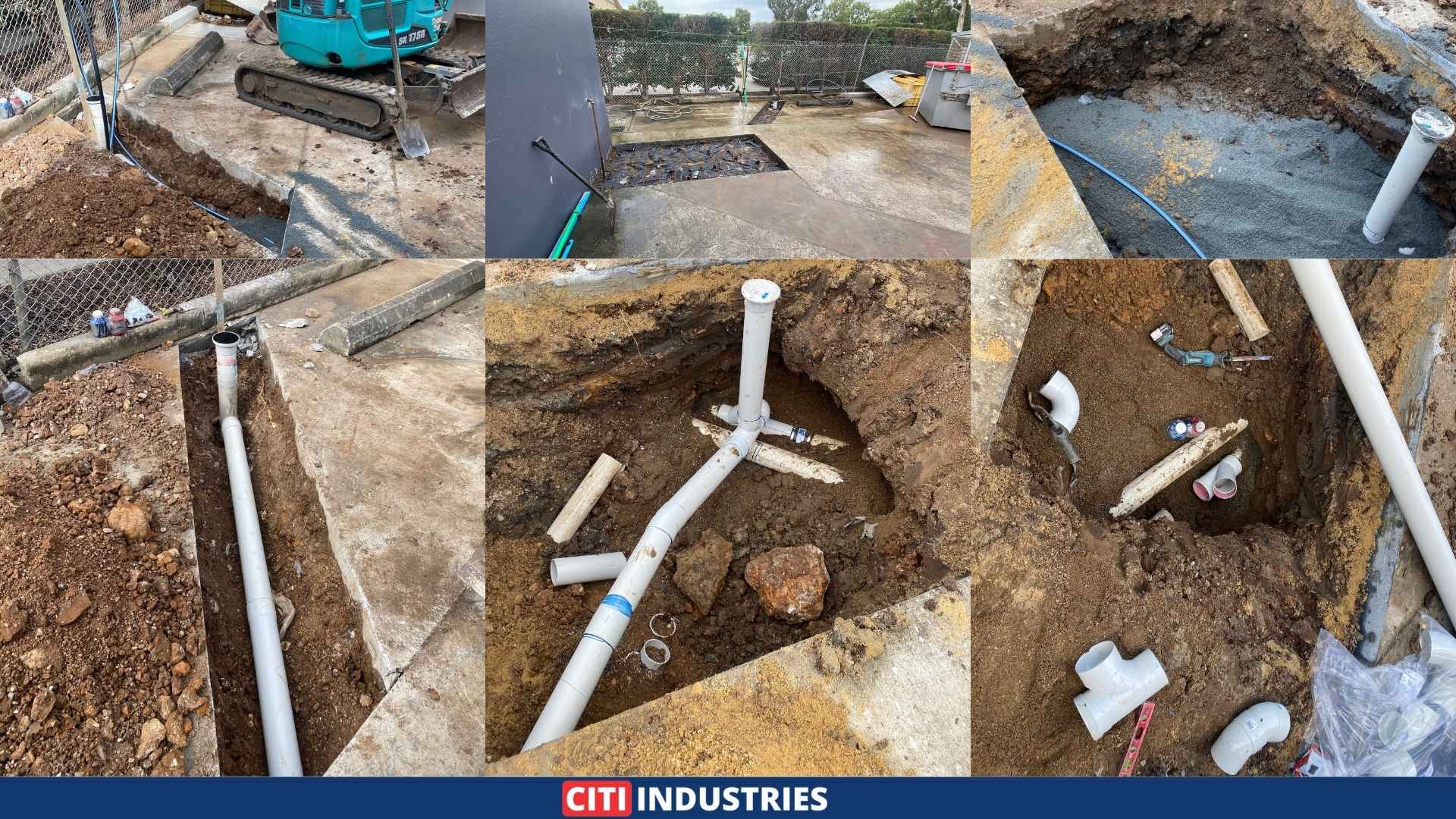
Trade waste plumbing system installation showing excavation and below-ground drainage pipework at a commercial kitchen facility in Darra, Queensland.

Challenges

The facility had been operating with an ageing below-ground grease trap that could no longer handle the volume of fat, oil, and grease (FOG) generated by daily food production. Over time, the system reached its capacity and began presenting serious compliance risks.

Key issues included:

  • A deteriorating grease trap approaching structural failure
  • Internal plumbing that no longer met modern trade waste requirements
  • Hot and cold water infrastructure unable to support operational demand
  • Kitchen fixtures requiring compliant trade waste connections
  • Increasing risk of grease trap compliance failure under Queensland plumbing regulations

For a facility operating at full production, the only viable solution was a complete trade waste plumbing upgrade designed for long-term reliability and compliance.

Operational Constraints

Moreover, we delivered the upgrade while the facility stayed fully operational. Meanwhile, we carefully staged concrete scanning, cutting, excavation, and plumbing works around production schedules. Additionally, we fully barricaded all work zones, maintaining safety while production continued. It required tight coordination between the Citi Industries crew and the facility’s operations team from day one.

Grease Trap Decommissioning

Furthermore, the team safely decommissioned the existing grease trap, eliminating long-term structural and environmental risks. Simply abandoning the tank in place was never an option. Then, we filled the tank with gravel and sand and concreted it over, preventing subsidence and contamination.

Trade Waste Compliance

All works were completed in accordance with the Plumbing and Drainage Act 2018 (Qld) and the pre-treatment requirements outlined in Unitywater’s Trade Waste Guidelines. The new 2,000L grease trap and trade waste drainage system were installed strictly according to the approved hydraulic plan.

Water Safety and System Design

To protect the potable water supply, an RPZD backflow prevention device was installed near the grease trap. Additionally, we installed a hot water ring main with a Grundfos pump and Rheem unit, maintaining consistent temperatures throughout. Unlike a straight-run hot water system, a ring main keeps water at temperature continuously, eliminating long wait times and water wastage during peak production hours.

Underground drainage and tradewaste pipework installation in Darra QLD showing trench excavation, pipe connections, drainage channel in gravel bed, and internal sanitary pipework.

What Was Delivered

With the groundworks done and the old infrastructure properly dealt with, the focus shifted to building a system that would actually perform under the demands of daily food production. The scope covered both the external drainage network and a full internal hydraulic fit-out.

External Drainage and Grease Trap Installation

The centrepiece of the external works was the supply and installation of a 2,000 litre below-ground grease trap installation for commercial kitchens, sized to handle the trade waste volumes this facility generates every single day.

Scope of works included:

  • Supply and installation of a 2,000L below-ground grease trap with Class D vehicular traffic lid
  • Concrete scanning, cutting, removal, and reinstatement across affected areas
  • Installation of new trade waste drainage lines throughout the tenancy
  • Venting of both the grease trap and trade waste line to atmosphere
  • Full decommissioning of the existing grease trap
  • Capping of redundant underground pipework
  • Installation of 9 bucket traps across the commercial kitchen drainage network
  • Installation of an RPZD backflow prevention valve
  • Full barricading of affected areas during construction

The nine bucket traps are worth calling out specifically. Positioned at each fixture, they capture food solids and debris at the point of source before they travel into the drainage line. This protects the downstream system from premature blockage and significantly extends the time between grease trap pump-outs. It is a straightforward measure that makes a real difference to how the system performs over time.

Internal Hydraulic Plumbing Fit-Out

Inside the facility, we rebuilt the plumbing to support a working production kitchen’s demands. Additionally, we completed cold water rough-in throughout and installed a ring main hot water system, fed by a Grundfos pump and Rheem unit.

The ring main configuration was a deliberate choice. In a large production kitchen, a straight-run system means long wait times at the tap and significant water wastage during busy periods. A ring main keeps water moving and at temperature continuously, which matters when the kitchen is running at full capacity.

Sanitary plumbing was installed throughout, and all kitchen fixtures were connected to the new commercial kitchen plumbing installation in accordance with the approved hydraulic design. Fixtures connected included 4 basins, 2 wash sinks, commercial tapware, and a new boot wash station, all supplied by the client.

Three-panel photo showing blue grease trap being lowered and set into excavation inside a commercial facility in Darra QLD.

Final Outcome

The project came in on schedule and the facility now has a trade waste plumbing system that was built properly from the ground up, with the capacity to support serious production demands for years to come.

With the new infrastructure in place, the facility now benefits from:

  • A high-capacity grease trap installation in Queensland designed for heavy food production loads
  • A compliant trade waste drainage system meeting Queensland standards
  • Reliable hot water delivery across the entire production area
  • Nine bucket traps protecting the drainage system at the point of source
  • Reduced risk of grease trap compliance issues or operational disruption
  • All internal kitchen fixtures connected and fully operational

As outlined in the National Construction Code Volume Three, Plumbing Code of Australia, commercial hydraulic systems must meet defined minimum standards for flow, drainage, and health protection. Furthermore, we delivered every element against those benchmarks, so the facility stays compliant as requirements evolve.

For this facility, the real outcome was straightforward. No more compliance exposure from ageing infrastructure, a hot water system that performs reliably under production load, and a trade waste system that will not need revisiting for years to come.

Need a Grease Trap Installation for Your Commercial Kitchen?

If your commercial kitchen, food production facility, or hospitality venue is running on ageing trade waste infrastructure, the time to act is before compliance becomes a problem rather than after. Indeed, Citi Industries delivers end-to-end solutions and gets it done right the first time.

  • Learn more about our commercial grease trap installation services and how we deliver compliant systems for commercial kitchens and food production facilities across Queensland.
  • Explore our trade waste plumbing solutions for end-to-end hydraulic fit-outs including drainage, backflow prevention, and hot water systems.
  • Find out about our commercial kitchen drainage systems and how we protect your drainage network from the point of source.

Call us on 1300 002 484 Monday to Friday, 7am to 6pm, or send us your details online and we will get back to you with a detailed scope and quote.

Primary Sidebar

BROCHURE

Wash Bay Design
& Construct

OPEN & DOWNLOAD NOW

BROCHURE

Grease Trap
Supply & Install

OPEN & DOWNLOAD NOW

BROCHURE

Commercial
Plumbing

OPEN & DOWNLOAD NOW

BROCHURE

Hydraulic
Design

OPEN & DOWNLOAD NOW

Product categories

  • Septic Tanks
  • Hydraulic Design Products
  • Industrial and Commercial Grease Trap Products
    • Above Ground
    • Below Ground
  • Bollards
  • Safety Mirrors
  • Speed Humps
  • Wheel Stops & Chocks
  • Pumps Stations
    • Diaphragm Pumps
    • Sewer Pump Stations
    • Stormwater Pump Stations
  • Oil Water Separators

BROWSING HISTORY

  • 800MM STAINLESS STEEL OUTDOOR CONVEX SAFETY MIRROR 800MM STAINLESS STEEL OUTDOOR CONVEX SAFETY MIRROR
  • 1500 LITRE VIKING PT ABOVE GROUND GREASE TRAP 1500 LITRE VIKING PT ABOVE GROUND GREASE TRAP
  • 3000 LITRE HALGAN BELOW GROUND GREASE TRAP 3000 LITRE HALGAN BELOW GROUND GREASE TRAP

INFORMATION

  • About Us
  • Contact Us

SEE HOW WE CAN HELP WITH YOUR PROJECT

  • This field is for validation purposes and should be left unchanged.

GIVE US A CALL

1300 002 484

MON-FRI | 7am – 6pm

Check out our Products
and Services

  • Wash Bays
  • Grease Traps
  • Plumbing

Home

  • About
  • Case Studies
  • Grease Traps
  • Blog
  • Wash Bays
  • Contact Us
  • Plumbing

MY ACCOUNT

  • Security Policy
  • Privacy Policy
  • Returns Policy
  • Conditions of Use

We Accept

LET’S CONNECT

  • Facebook
  • Twitter
  • Instagram

PO Box 1449, Coorparoo QLD 4151
1300 002 484
© CitiIndustries.com.au | All Rights Reserved | Sitemap

Our Spring Sale Has Started

You can see how this popup was set up in our step-by-step guide: https://wppopupmaker.com/guides/auto-opening-announcement-popups/

Get the latest
free ebook

brochure title here


  • This field is for validation purposes and should be left unchanged.

Privacy Policy

  • This field is for validation purposes and should be left unchanged.
  • SUBMIT YOUR ENQUIRY AND WE WILL RESPOND SHORTLY

  • This field is hidden when viewing the form
  • If you prefer you can call us on 1300 002 484 Mon-Fri 7am-6pm